
New Delhi: A senior navy officer, who played a crucial role in the acquisition of Admiral Gorshkov, the Russian aircraft carrier, has been placed under the scanner. Investigators are looking into whether commodore Sukhjinder Singh’s proximity to some Russians was in any way linked to problems associated with the Gorshkov project, including the escalation in cost as well as delays. Singh was in charge of the aircraft carrier project in Russia, and had been stationed there for many years. The commodore was deputed there to supervise the re-fitting and technical requirements. The probe also focuses on his improper personal conduct.
The carrier has for long been in focus for the quantum jump in its cost — the project cost has gone up from Rs4,870 crore in 2004 to Rs11,650 crore currently. In the second week of March, during Russian prime minister Vladimir Putin’s visit to New Delhi, India had — in a controversial move — agreed to pay $2.33 billion for the refitting as against the original $974 million agreed upon in 2004. Singh was posted in Russia until about three years ago, and was probably the senior-most officer there to oversee the Gorshkov project. On his return to Delhi, he was appointed to the crucial post of principal director (aircraft carrier project) looking after the Gorshkov project from the headquarters. All of this underlines Singh’s extensive involvement in the project.
According to the navy, the formal inquiry against Singh, who till some months ago was the principal director of the project, started a few weeks ago. It was ordered after incriminating evidence emerged showing his links to some Russians.
DNA has material to establish the commodore’s involvement in activities which were unbecoming of an officer of his rank and stature.
Confirming the inquiry, a navy spokesperson told DNA, “The IN (Indian Navy) has received information about a senior naval officer who has been involved in an act of loose moral conduct. The navy has instituted an inquiry to establish whether this had any influence on the performance of his official duties. Preliminary indications are that the involvement has been at a personal level.”
A navy source said the inquiry is looking into “all aspects” of Singh’s conduct, including whether his behaviour in Russia and proximity to some Russian individuals has had any “impact on the Gorshkov deal”. The concern is whether those individuals were part of a larger conspiracy of the Russian arms industry.
The Gorshkov project took a bizarre turn when Russians demanded in mid-2008 a massive price hike for the refit, leading to many within the navy and outside to suggest scrapping the entire project. In fact, questions continue to swirl about the logic of price hike. The carrier, which was originally slated to be delivered in 2008, is now only expected in 2012. Again, through it all, Singh has had a crucial role.
A navy source told DNA that “preliminary evidence” indicates that Singh may not have played any significant role in deciding the new price.
However, Singh was a member of the cost negotiation committee (CNC) set up last year to resolve the unprecedented Russian demand for increase in refit cost. According to naval records, Singh sat through the first meeting of the CNC last year. The CNC comprised at least three admirals from the navy, some three joint secretary rank officers and others. Singh was among the junior-most.
“The inquiry is going through the records” of the CNC, sources confirmed. The one man investigation, a formal court of inquiry, would “sum up in the next few days”, they said.
Connections, implications
Project cost of Admiral Gorshkov has gone up from Rs4,870 crore in 2004 to Rs11,650 crore currently Singh was in charge of the aircraft carrier project in Russia and had been stationed there for many years Sources in the intelligence set-up said incriminating evidence detailing Singh’s improper conduct was made available to naval authorities, prompting them to start the inquiry
Investigators are also looking at his Russian contacts and if they had any links to the Russian arms industry, as well as if some of those close associations could have influenced his conduct in the Gorshkov deal
Source: http://www.dnaindia.com/india/report_conduct-of-senior-naval-officer-in-gorshkov-project-under-scanner_1370307
Showing posts with label officer. Show all posts
Showing posts with label officer. Show all posts
Monday, April 12, 2010


Sunday, March 28, 2010
Jawans sans home and hearth
NEW DELHI: Leave alone supersonic fighter jets or complex ballistic missile defence systems, the defence establishment seems incapable of even providing something as basic as decent family accommodation to its armed forces.
Even as the defence ministry flounders, deadline after deadline of the much-touted Married Accommodation Project (MAP), touted as a major welfare measure for soldiers, airmen and sailors, is being missed with huge cost escalation.
Consequently, while officers have it relatively easy, a majority of jawans are forced to stay away from their families for prolonged periods, which is one of the factors cited for the high levels of stress prevalent in the forces. Incidentally, the 13 lakh-strong armed forces record over 120 suicide and 'fragging' cases every year.
MAP was conceived a decade ago to ameliorate some of the hardship faced by jawans since there was limited housing available for married personnel. Though the aim was to construct just 1,98,881 new dwelling units, in four phases at an estimated cost of Rs 17,357 crore, it was considered a good beginning.
But it has flattered to deceive. In May 2002, the Cabinet Committee on Security approved construction of 61,658 dwelling units under phase-I, which were to be ready by 2005-2006.
Eight years later, even after the number of units to be constructed was reduced to 58,391 in 86 military stations at a cost of Rs 5,329 crore, phase-I is yet to be completed. "Only about 42,000 units are ready till now," said an official.
"The less said about phase-II the better. Under it, 66,727 units have to be constructed in a compressed timeframe by March 2012. It will simply not be possible," he said.
MoD, on its part, says phase-II will not be branched off to PSUs, like it was in phase-I. Defence minister A K Antony has 'directed' senior officials to ensure 'strict adherence' to the March 2012 deadline.
While 75% of the work in phase-II will be executed directly by the directorate general of MAP, the other 25% will be handled by MES (military engineering service), to avoid slippages and cost escalation.
But given the track record of both MAP and MES till now, the timely execution of phase-II, at a cost of Rs 9,938 crore, is likely to remain a pipedream.
Moreover, no definite timeframes for phase-III and IV, under which over 70,000 units are to be constructed, have been chalked out in detail. MoD officials, however, said the government had 'agreed in principle' to combine the last two phases to complete the entire MAP 'at the earliest'.
Source: http://timesofindia.indiatimes.com/india/Jawans-sans-home-and-hearth/articleshow/5736893.cms
Even as the defence ministry flounders, deadline after deadline of the much-touted Married Accommodation Project (MAP), touted as a major welfare measure for soldiers, airmen and sailors, is being missed with huge cost escalation.
Consequently, while officers have it relatively easy, a majority of jawans are forced to stay away from their families for prolonged periods, which is one of the factors cited for the high levels of stress prevalent in the forces. Incidentally, the 13 lakh-strong armed forces record over 120 suicide and 'fragging' cases every year.
MAP was conceived a decade ago to ameliorate some of the hardship faced by jawans since there was limited housing available for married personnel. Though the aim was to construct just 1,98,881 new dwelling units, in four phases at an estimated cost of Rs 17,357 crore, it was considered a good beginning.
But it has flattered to deceive. In May 2002, the Cabinet Committee on Security approved construction of 61,658 dwelling units under phase-I, which were to be ready by 2005-2006.
Eight years later, even after the number of units to be constructed was reduced to 58,391 in 86 military stations at a cost of Rs 5,329 crore, phase-I is yet to be completed. "Only about 42,000 units are ready till now," said an official.
"The less said about phase-II the better. Under it, 66,727 units have to be constructed in a compressed timeframe by March 2012. It will simply not be possible," he said.
MoD, on its part, says phase-II will not be branched off to PSUs, like it was in phase-I. Defence minister A K Antony has 'directed' senior officials to ensure 'strict adherence' to the March 2012 deadline.
While 75% of the work in phase-II will be executed directly by the directorate general of MAP, the other 25% will be handled by MES (military engineering service), to avoid slippages and cost escalation.
But given the track record of both MAP and MES till now, the timely execution of phase-II, at a cost of Rs 9,938 crore, is likely to remain a pipedream.
Moreover, no definite timeframes for phase-III and IV, under which over 70,000 units are to be constructed, have been chalked out in detail. MoD officials, however, said the government had 'agreed in principle' to combine the last two phases to complete the entire MAP 'at the earliest'.
Source: http://timesofindia.indiatimes.com/india/Jawans-sans-home-and-hearth/articleshow/5736893.cms
Saturday, March 20, 2010
Brigadier on wheelchair to be Major General
NEW DELHI: In a stirring achievement, a paraplegic Army officer confined to a wheelchair, Brigadier S K Razdan, is all set to become a two-star officer or a major-general.
While this is not the first time that physically challenged officers have reached high ranks, with at least two having even become senior three-star officers or Lt-Generals, the feat is possible only through steely determination and sheer grit.
Brig Razdan was a Lt-Col in the special forces when he participated in an intensive counter-terrorism operation in Damal Kunzipur area of Jammu and Kashmir in October 1994 to save several Muslim women taken hostage by militants. While the women were successfully rescued, the brave officer suffered grave injuries to his spinal cord, leaving him paralyzed below the waist.
A grateful nation awarded him the Kirti Chakra, the nation's second-highest peacetime gallantry award, in 1996 for his act of valour. The wheelchair-bound officer later went on to become a brigadier. And now, Brig Razdan has been approved to become a major-general and will `pick up his rank' once there is a vacancy.
"As per Army rules, any injury or disability suffered in war, counter-terrorism or any other operation, which is called a `battle casualty', does not come in the way of any soldier in his promotion boards as long as he is capable of performing his duties,'' said a senior officer.
However, if a soldier suffers a `physical casualty', that is, gets disabled in training or an accident, then there is no recourse but to put him in a lower medical category. He is allowed to serve if he can perform his duties but there is a bar on him getting promoted or attending some particular courses. Otherwise, he is boarded out.
Take, for instance, Lt-Gen Pankaj Joshi, who passed away last year. Commissioned into the Gorkha Rifles in 1962, he lost both his legs during a mine-clearing mission in Sikkim in 1967. But through sheer grit after becoming a `battle casualty', he went on to command an armoured brigade, an armoured division and a corps before becoming the general officer commanding-in-chief of the Lucknow-based Central Army Command.
That's not all. Lt-Gen Joshi also became India's first-ever chief of the tri-Service integrated defence staff in October 2001, established in the aftermath of the 1999 Kargil conflict, and retired after a fruitful tenure.
The 1.13-million strong Indian Army, in fact, has also had a disabled Lt-Gen as it vice-chief. Lt-Gen Vijay Oberoi, who lost one of his legs during an operation as a young officer, served as the vice-chief in 2000-2001 after first serving as the director-general of military operations, a strike corps commander and then chief of the Chandimandir-based Western Army Command.
Source: http://timesofindia.indiatimes.com/india/Brigadier-on-wheelchair-to-be-major-general/articleshow/5703111.cms
While this is not the first time that physically challenged officers have reached high ranks, with at least two having even become senior three-star officers or Lt-Generals, the feat is possible only through steely determination and sheer grit.
Brig Razdan was a Lt-Col in the special forces when he participated in an intensive counter-terrorism operation in Damal Kunzipur area of Jammu and Kashmir in October 1994 to save several Muslim women taken hostage by militants. While the women were successfully rescued, the brave officer suffered grave injuries to his spinal cord, leaving him paralyzed below the waist.
A grateful nation awarded him the Kirti Chakra, the nation's second-highest peacetime gallantry award, in 1996 for his act of valour. The wheelchair-bound officer later went on to become a brigadier. And now, Brig Razdan has been approved to become a major-general and will `pick up his rank' once there is a vacancy.
"As per Army rules, any injury or disability suffered in war, counter-terrorism or any other operation, which is called a `battle casualty', does not come in the way of any soldier in his promotion boards as long as he is capable of performing his duties,'' said a senior officer.
However, if a soldier suffers a `physical casualty', that is, gets disabled in training or an accident, then there is no recourse but to put him in a lower medical category. He is allowed to serve if he can perform his duties but there is a bar on him getting promoted or attending some particular courses. Otherwise, he is boarded out.
Take, for instance, Lt-Gen Pankaj Joshi, who passed away last year. Commissioned into the Gorkha Rifles in 1962, he lost both his legs during a mine-clearing mission in Sikkim in 1967. But through sheer grit after becoming a `battle casualty', he went on to command an armoured brigade, an armoured division and a corps before becoming the general officer commanding-in-chief of the Lucknow-based Central Army Command.
That's not all. Lt-Gen Joshi also became India's first-ever chief of the tri-Service integrated defence staff in October 2001, established in the aftermath of the 1999 Kargil conflict, and retired after a fruitful tenure.
The 1.13-million strong Indian Army, in fact, has also had a disabled Lt-Gen as it vice-chief. Lt-Gen Vijay Oberoi, who lost one of his legs during an operation as a young officer, served as the vice-chief in 2000-2001 after first serving as the director-general of military operations, a strike corps commander and then chief of the Chandimandir-based Western Army Command.
Source: http://timesofindia.indiatimes.com/india/Brigadier-on-wheelchair-to-be-major-general/articleshow/5703111.cms
Kargil war hero now fights a court battle
New Delhi: Almost 10 years after the Kargil war, the Armed Forces Tribunal has started hearing the first of Kargil war-related cases.
Brigadier Devinder Singh, considered to be the man behind the Batalik victory, has alleged that his seniors denied him and his formation their due contribution in this critical battle by fudging battle reports.
The hero of Batalik many believe led the Indian Army to one of its toughest and finest victories in the Kargil battle.
Now Brigadier Devinder Singh, then commander of the 70 Infantry Brigade, is fighting another battle at the Armed Forces Tribunal.
He has alleged that top commanders fabricated war records to deny him and his formation credit for the winning Point 5203.
At the centre of these allegations are serious irregularities.
The official citation given to Brigadier Singh for gallantry, a copy of which is with CNN-IBN hails his leadership. Yet all this battle valour meant nothing.
Brigadier Singh was passed over for promotion and received a Vishisht Seva Medal, normally given for peacetime duties.
The second big loophole is the citation that clearly says he personally led the critical battle and continued to fight unmindful of his personal safety.
But the battle performance report made by his senior, the then GoC of 15 corps, Lt Gen Kishan Pal said that Brigadier Singh had little to do with the success in Batalik.
The third lapse is an after-action report prepared by Lt Gen Pal's headquarters that claims that it was a certain Brigadier Duggal who had control of four battalions which led the assault.
Officers of these units have directly disputed the claim.
So where does the truth lie?
Brigadier Singh alleges that his senior and the GoC of 15 Corps Lt Gen Kishan Pal is trying to cover up his own error in judgement that only 45 terrorists were hiding in the Batalik sub sector instead of the 600 Brigadier Singh claimed he was confronting.
Brigadier Singh's assessment was later proved correct.
So who won Batlaik, were top generals protecting themselves from their gross underestimation? It's a battle that could well change the course of military history.
Source: http://ibnlive.in.com/videos/111769/kargil-war-hero-now-fights-a-court-battle.html
Wednesday, March 17, 2010
Update: Top military brass against permanent commission to women officers
NEW DELHI: Women may have had a long history in military, right from the days of Joan of Arc or even Jhansi ki Rani, but the Indian military brass remains dead against granting permanent commission (PC) to women officers across the board due to what they call `operational, practical and cultural problems'.
Women are being inducted into armed forces as officers since the early-1990s, and many of them have served with distinction, but they can only don their uniforms for a maximum of 14 years even now as short-service commission (SSC) officers. At the most, they can become Lt-Colonels and their equivalents in IAF and Navy in these 14 years.
Many women officers, serving and retired, do not agree with the `double standards' practised in armed forces. "On one hand, the forces keep cribbing about the shortage of officers. On the other, they are perfectly willing to let go of this (women) well-trained and available human resource,'' said a Major.
The government in 2008 did issue orders for PC for women officers but, in what many saw as mere lip-service to gender equality, it was restricted to just the legal and education wings of the three Services, as also IAF's accounts branch and Navy's `naval constructor' department.
The reason was plain and simple. These wings do not involve command of men or battalions. "Women officers have neither been trained for command nor given the responsibility so far,'' a senior officer told TOI on Friday.
"We are going in for having a large SSC base and a lean PC cadre. Granting PC to existing women SSC officers will hit the entire restructuring process. Grant of PC to women must be based on military needs and organisational requirements, not social considerations or pressure exerted by some groups. It has to be a gradual process,'' he added.
But how gradual will the process be? The 2009 batch of SSC women cadets currently undergoing training in the Officers' Training Academy at Chennai or IAF Academy at Dundigal, for instance, will be given the option to choose PC in the legal or education branches just a year or two before they complete 10 years in service. As per existing policy, no serving women officer can get PC.
Some women officers contend they often face a condescending attitude from their colleagues and seniors in the predominantly-male environment of the 13-lakh strong armed forces, where they constitute barely 2.5% to 6% of the officer cadre. Women, of course, are not inducted as PBORs (personnel below officer rank).
"In many fields, like engineering, signals or even flying, women have done better than their male counterparts. So, what is the problem if they are given PC? It's tough to get a second career at 35-40,'' says a woman officer.
Yes, there are operational problems, with the overwhelming chunk of the Army deployed along the borders or in counter-insurgency operations, but women officers can certainly be considered for PC in wings like engineering, ordnance, intelligence, signals, logistics, air traffic control and the like, which will not take them directly to the battlefront.
The military brass, however, holds it's essential to obtain feedback on the performance of women based on the now revised pre-commission training (from the earlier 24 weeks to the present 49 weeks), detailment on courses such as junior command course and assess their performance as sub-unit commanders especially in field areas for holding higher ranks and grant of PC.
Source: http://timesofindia.indiatimes.com/india/Top-military-brass-against-permanent-commission-to-women-officers/articleshow/5677653.cms
Women are being inducted into armed forces as officers since the early-1990s, and many of them have served with distinction, but they can only don their uniforms for a maximum of 14 years even now as short-service commission (SSC) officers. At the most, they can become Lt-Colonels and their equivalents in IAF and Navy in these 14 years.
Many women officers, serving and retired, do not agree with the `double standards' practised in armed forces. "On one hand, the forces keep cribbing about the shortage of officers. On the other, they are perfectly willing to let go of this (women) well-trained and available human resource,'' said a Major.
The government in 2008 did issue orders for PC for women officers but, in what many saw as mere lip-service to gender equality, it was restricted to just the legal and education wings of the three Services, as also IAF's accounts branch and Navy's `naval constructor' department.
The reason was plain and simple. These wings do not involve command of men or battalions. "Women officers have neither been trained for command nor given the responsibility so far,'' a senior officer told TOI on Friday.
"We are going in for having a large SSC base and a lean PC cadre. Granting PC to existing women SSC officers will hit the entire restructuring process. Grant of PC to women must be based on military needs and organisational requirements, not social considerations or pressure exerted by some groups. It has to be a gradual process,'' he added.
But how gradual will the process be? The 2009 batch of SSC women cadets currently undergoing training in the Officers' Training Academy at Chennai or IAF Academy at Dundigal, for instance, will be given the option to choose PC in the legal or education branches just a year or two before they complete 10 years in service. As per existing policy, no serving women officer can get PC.
Some women officers contend they often face a condescending attitude from their colleagues and seniors in the predominantly-male environment of the 13-lakh strong armed forces, where they constitute barely 2.5% to 6% of the officer cadre. Women, of course, are not inducted as PBORs (personnel below officer rank).
"In many fields, like engineering, signals or even flying, women have done better than their male counterparts. So, what is the problem if they are given PC? It's tough to get a second career at 35-40,'' says a woman officer.
Yes, there are operational problems, with the overwhelming chunk of the Army deployed along the borders or in counter-insurgency operations, but women officers can certainly be considered for PC in wings like engineering, ordnance, intelligence, signals, logistics, air traffic control and the like, which will not take them directly to the battlefront.
The military brass, however, holds it's essential to obtain feedback on the performance of women based on the now revised pre-commission training (from the earlier 24 weeks to the present 49 weeks), detailment on courses such as junior command course and assess their performance as sub-unit commanders especially in field areas for holding higher ranks and grant of PC.
Source: http://timesofindia.indiatimes.com/india/Top-military-brass-against-permanent-commission-to-women-officers/articleshow/5677653.cms
Sunday, March 7, 2010
A pilot's moment of glory - by Flt Lt MP Anil Kumar
The Indian Air Force uses the Kiran aircraft, manufactured by Hindustan Aeronautics Limited, for both basic and advanced flying training including weaponry. Kiran is a two-seat trainer. On solo sorties, the pilot tenants the left seat and the right seat is vacant.
October 29, 1984. Sarmat air-to-ground range, Jamnagar, Gujarat. 3.20 pm
Nirmal, flying solo in a Kiran, was turning left sharply to align with the practice target for the first pass of firing front guns. As he was more than halfway through the turn north, in a twinkle, he flew through a flock of cranes and heard several thuds of these critters smashing into the airframe.
One bird crashed into the windshield, splintered it, hit the starter panel, ricocheted into his face and smacked his head hard like a heavyweight boxer's uppercut. It stamped splotches of hotchpotch of meat, blood and plumage on his bone dome (helmet) visor. The unexpected blow, the temporary blinding, the flying smithereens and the piercing noise discomposed him. It made his hair stand on end.
Though he panicked, he reflexively got the wings level, raised the visor and coaxed the Kiran into a climb to gain height, with the intention of returning to base. He glanced at the engine instruments; the parameters were okay. After checking the wake for signs of smoke, he ruled out fire, and opened full throttle to power the climb. The flying controls were alright. Panic subsided.
The compass read 020. He quickly inspected the wings and the left air intake, and found a massive hole on the leading edge of the left wing. Out of the blue, he heard the sound every pilot dreads -- of the engine unwinding and going silent. The engine had quit -- a dire emergency. Despite the loud windblast, he could hear his palpitating heart. Every nerve and sinew turned taut.
For reasons of aerodynamics, you always take off and land into the wind. Runways are constructed depending on the prevailing winds in the place, and are specified in two digits after docking the last digit of its three-digit magnetic bearings. For example, if the lay of the runway is east-west, the orientation is 090-270, and the runway is addressed as 09 and 27.
Sarmat Range is situated west to northwest of Jamnagar airfield and along the Gulf of Kutch. At the time of the flame out, Nirmal was northwest and approximately six kilometres away from runway 06. With the engine thrust gone, height was of paramount importance, and therefore he continued the climb to convert extra speed into height. As the speed washed off rapidly and the aircraft approached the vertex of the climb, he smoothly manoeuvred the Kiran into a right descending turn onto heading 140, and flew at the gliding speed of 130 knots (240 kph).
Kiran has a small panel (starter panel) mounted atop the main instrument panel that contains circuit-breakers and switches to operate both the engine and armaments. During the descending turn, Nirmal was nonplussed to detect that the bird strike had flattened the starter panel to near horizontal position. He straightened the starter panel, flicked the armament switches to safe positions, reset all the engine switches and circuit-breakers except the guarded LP (low pressure) cock switch as he could not discern whether it had tripped or not.
As the compass needle advanced to 140, he made an assessment of his position. It was a bright day, the visibility was infinite and he could see the Jamnagar runway and beyond clearly. The altimeter read 2100 feet and he had under six kilometres to traverse to runway 06. Given the likely rate of descent, he reckoned force-landing was possible, but it would be touch-and-go because of the additional drag produced by the damaged airframe, the knocked-out windshield and the two front gun pods fixed to the underwing pylons. He mentally charted the flight path he would follow to join the final approach for landing. He commenced a left descending turn to follow the flight path he drew up. The nerves eased up.
He thought of an attempt to relight (restart) the engine, but scrapped the idea as he presumed bird ingestion was the cause of engine failure. The hydraulic pressure was okay, but with a dead engine, he had to utilise the residual hydraulic pressure judiciously. So he decided to use it to lower the undercarriage only, and would not down the flaps although a flapless final approach was exacting to execute. To stretch the glide, he would delay the lowering of undercarriage. He tightened all harness-straps, just in case he had to forsake force-landing and eject.
Though RT (radio telephony) was inaudible with heavy background noise due to the windblast, he changed over to Jamnagar ATC (Air Traffic Control) frequency, and screamed, "Mayday, mayday, mayday..." and announced his intention to force land on runway 06. He had a quick glance at the Air Speed Indicator; the speed had dropped below 130 knots (because of extra drag). He lowered the nose some more to increase speed to 130 knots, but he would have to tighten the glide to make up for the loss of height. "Can I make it?" he reassessed the situation. "Yes, just about, but I have to be on the ball and fly by the seat of my pants," he braced himself. He continued the descent, on a wing and a prayer.
As he neared the finals, he raised the nose a bit to reduce speed gradually to 105 knots -- the speed for flapless approach. Speed 105 knots. Glide -- perfect. As he patted himself, to his mortal horror, he found an aircraft lining up for take-off. "He's going to balk my landing," he cringed. His heart pounded in his mouth again. He hollered on RT telling him to clear off. To no avail. He bellowed again, which sounded more like a full-throated plea. Even Providence must have heard it, for, the offending aircraft vamoosed into a nearby pen.
He regained his breath and heartbeat, and stole a glimpse of the hydraulic pressure gauge.
Popularly known as Fido, Flight Lieutenant Rajendra Singh was in a Kiran waiting to line up for take-off. He was one of Nirmal's flying instructors, and both were alumni of the Sainik School, Kazhakootam, Kerala [Images].
Fido had fixated his focus on Nirmal's struggle to force land, and was pleased when Nirmal adeptly intercepted the glide path for a flapless landing. But something was amiss. "Check undercart," he prompted on RT, and soon beheld the three wheels lowering but slower than normal. As Nirmal rounded off the Kiran over the runway threshold for touchdown, his (Fido's) chest swelled with pride. But what he saw deflated the pectoral swell and made him jump out of his skin.
The canopy of Nirmal's aircraft rocketed skywards followed in a trice by the ejection seat. In no time, the seat with Nirmal strapped to it reached the cusp of its trajectory and then tumbled down. The drogue chute opened and immediately stabilised the descent. Fido's heart skipped a beat. The Kiran has a Martin-Baker ejection seat and the minimum forward speed to eject at ground level is 90 knots. What if Nirmal had decelerated below 90 knots when he rounded off? But before the consequences of this doubt paralysed him, he was sighing at the sight of the main parachute fully deploying when Nirmal was only inches above the runway.
It was a whisker. He could almost hear the thwack of Nirmal's boots landing hard on the runway. Fido just witnessed a live ejection.
Pilot Officer O M Nirmal Kumar, with barely 200 hours of flying experience, nearly pulled off an improbable forced landing of a crippled jet. Jet pilots will vouch that to force-land a jet is the devil's own job, and Nirmal made a damned good fist of it.
To put things in perspective, the elapsed time between the bird hit and the ejection was mere 100 seconds. Yes, one minute and 40 seconds! The tumultuous final approach lasted just 11 seconds! Here's to Nirmal for that masterly effort 23 Octobers ago.
Aftermath
The parachute opened just in time to break his landing shock on the concrete runway, which left both his ankles badly sprained and swollen. He was hospitalised, and put on lumbar traction for few days. Poultice and hot fomentation shrunk the swellings. Fortunately, there were no other injuries, and he was back in the cockpit before long.
Autopsy
An engine failure could not be freakier. The aircraft suffered extensive airframe damage but no bird was sucked into the engine. Kiran uses a low-pressure (LP) cock to regulate fuel supply to the engine. Switching off LP leads to fuel starvation and the engine shuts down in few seconds. Though the LP switch in the starter panel has a guard, the bird collision on the starter panel was hard enough to trip the switch through the guard! This was what caused the engine failure!
But why did he eject, not land? In the cockpit, when the undercarriage (wheels) is down and locked, three green lamps illuminate (pilots refer to this as three greens), each lamp indicating the position of the three wheels. When you lower the undercarriage in the air, three red lamps light up to signal its unlocking and unsafe position, and onto three greens when they lock down fully.
Fido's reminder to lower undercart coincided with Nirmal checking the hydraulic pressure. He lowered the undercart and kept a hawk's eye on the indicator. It's three reds all the way until he flared out over the runway threshold for touchdown, and therefore unsure of the wheels locking down. There he had to make the life-and-death call: To do a hazardous belly landing with the undercarriage in an unsafe position or to save himself through a risky ground-level ejection. When confronted to make that proverbial split-second decision, he settled on aborting the landing and ejected.
Whenever an aircraft with iffy RT/undercarriage approaches to land, it's the job of the ATC to fire a green/red flare to signal thumbs up/down for landing. In Nirmal's case, for the ATC, it was too close to call to fire either flare!
The sting in the tail
Here's what might have happened. Mind you, Nirmal was essaying to land on runway 06, and given the time (3.22 pm), the bright sun glowing behind his back made it tough to confirm three greens in the 11-second nerve-wracking home stretch. Simply, it was one of those days.
The last word
As often happens in military aviation, the aircraft had the last word! The undercart had locked down. As if unimpressed by her last nanosecond abandonment, she touched down, rolled on along the centre line of the runway and swerved left close to the middle-marker, and halted on the runway shoulder, thereby ensuring that she did not block the runway!
Maybe one can interpret that as her way of winking and saying 'cheers' to her captain's exceptional endeavour to bring her back home.
Flt Lt M P Anil Kumar is a former MiG-21 pilot.

Source: http://www.rediff.com/news/2007/oct/31anil.htm
October 29, 1984. Sarmat air-to-ground range, Jamnagar, Gujarat. 3.20 pm
Nirmal, flying solo in a Kiran, was turning left sharply to align with the practice target for the first pass of firing front guns. As he was more than halfway through the turn north, in a twinkle, he flew through a flock of cranes and heard several thuds of these critters smashing into the airframe.
One bird crashed into the windshield, splintered it, hit the starter panel, ricocheted into his face and smacked his head hard like a heavyweight boxer's uppercut. It stamped splotches of hotchpotch of meat, blood and plumage on his bone dome (helmet) visor. The unexpected blow, the temporary blinding, the flying smithereens and the piercing noise discomposed him. It made his hair stand on end.
Though he panicked, he reflexively got the wings level, raised the visor and coaxed the Kiran into a climb to gain height, with the intention of returning to base. He glanced at the engine instruments; the parameters were okay. After checking the wake for signs of smoke, he ruled out fire, and opened full throttle to power the climb. The flying controls were alright. Panic subsided.
The compass read 020. He quickly inspected the wings and the left air intake, and found a massive hole on the leading edge of the left wing. Out of the blue, he heard the sound every pilot dreads -- of the engine unwinding and going silent. The engine had quit -- a dire emergency. Despite the loud windblast, he could hear his palpitating heart. Every nerve and sinew turned taut.
For reasons of aerodynamics, you always take off and land into the wind. Runways are constructed depending on the prevailing winds in the place, and are specified in two digits after docking the last digit of its three-digit magnetic bearings. For example, if the lay of the runway is east-west, the orientation is 090-270, and the runway is addressed as 09 and 27.
Sarmat Range is situated west to northwest of Jamnagar airfield and along the Gulf of Kutch. At the time of the flame out, Nirmal was northwest and approximately six kilometres away from runway 06. With the engine thrust gone, height was of paramount importance, and therefore he continued the climb to convert extra speed into height. As the speed washed off rapidly and the aircraft approached the vertex of the climb, he smoothly manoeuvred the Kiran into a right descending turn onto heading 140, and flew at the gliding speed of 130 knots (240 kph).
Kiran has a small panel (starter panel) mounted atop the main instrument panel that contains circuit-breakers and switches to operate both the engine and armaments. During the descending turn, Nirmal was nonplussed to detect that the bird strike had flattened the starter panel to near horizontal position. He straightened the starter panel, flicked the armament switches to safe positions, reset all the engine switches and circuit-breakers except the guarded LP (low pressure) cock switch as he could not discern whether it had tripped or not.
As the compass needle advanced to 140, he made an assessment of his position. It was a bright day, the visibility was infinite and he could see the Jamnagar runway and beyond clearly. The altimeter read 2100 feet and he had under six kilometres to traverse to runway 06. Given the likely rate of descent, he reckoned force-landing was possible, but it would be touch-and-go because of the additional drag produced by the damaged airframe, the knocked-out windshield and the two front gun pods fixed to the underwing pylons. He mentally charted the flight path he would follow to join the final approach for landing. He commenced a left descending turn to follow the flight path he drew up. The nerves eased up.
He thought of an attempt to relight (restart) the engine, but scrapped the idea as he presumed bird ingestion was the cause of engine failure. The hydraulic pressure was okay, but with a dead engine, he had to utilise the residual hydraulic pressure judiciously. So he decided to use it to lower the undercarriage only, and would not down the flaps although a flapless final approach was exacting to execute. To stretch the glide, he would delay the lowering of undercarriage. He tightened all harness-straps, just in case he had to forsake force-landing and eject.
Though RT (radio telephony) was inaudible with heavy background noise due to the windblast, he changed over to Jamnagar ATC (Air Traffic Control) frequency, and screamed, "Mayday, mayday, mayday..." and announced his intention to force land on runway 06. He had a quick glance at the Air Speed Indicator; the speed had dropped below 130 knots (because of extra drag). He lowered the nose some more to increase speed to 130 knots, but he would have to tighten the glide to make up for the loss of height. "Can I make it?" he reassessed the situation. "Yes, just about, but I have to be on the ball and fly by the seat of my pants," he braced himself. He continued the descent, on a wing and a prayer.
As he neared the finals, he raised the nose a bit to reduce speed gradually to 105 knots -- the speed for flapless approach. Speed 105 knots. Glide -- perfect. As he patted himself, to his mortal horror, he found an aircraft lining up for take-off. "He's going to balk my landing," he cringed. His heart pounded in his mouth again. He hollered on RT telling him to clear off. To no avail. He bellowed again, which sounded more like a full-throated plea. Even Providence must have heard it, for, the offending aircraft vamoosed into a nearby pen.
He regained his breath and heartbeat, and stole a glimpse of the hydraulic pressure gauge.
Popularly known as Fido, Flight Lieutenant Rajendra Singh was in a Kiran waiting to line up for take-off. He was one of Nirmal's flying instructors, and both were alumni of the Sainik School, Kazhakootam, Kerala [Images].
Fido had fixated his focus on Nirmal's struggle to force land, and was pleased when Nirmal adeptly intercepted the glide path for a flapless landing. But something was amiss. "Check undercart," he prompted on RT, and soon beheld the three wheels lowering but slower than normal. As Nirmal rounded off the Kiran over the runway threshold for touchdown, his (Fido's) chest swelled with pride. But what he saw deflated the pectoral swell and made him jump out of his skin.
The canopy of Nirmal's aircraft rocketed skywards followed in a trice by the ejection seat. In no time, the seat with Nirmal strapped to it reached the cusp of its trajectory and then tumbled down. The drogue chute opened and immediately stabilised the descent. Fido's heart skipped a beat. The Kiran has a Martin-Baker ejection seat and the minimum forward speed to eject at ground level is 90 knots. What if Nirmal had decelerated below 90 knots when he rounded off? But before the consequences of this doubt paralysed him, he was sighing at the sight of the main parachute fully deploying when Nirmal was only inches above the runway.
It was a whisker. He could almost hear the thwack of Nirmal's boots landing hard on the runway. Fido just witnessed a live ejection.
Pilot Officer O M Nirmal Kumar, with barely 200 hours of flying experience, nearly pulled off an improbable forced landing of a crippled jet. Jet pilots will vouch that to force-land a jet is the devil's own job, and Nirmal made a damned good fist of it.
To put things in perspective, the elapsed time between the bird hit and the ejection was mere 100 seconds. Yes, one minute and 40 seconds! The tumultuous final approach lasted just 11 seconds! Here's to Nirmal for that masterly effort 23 Octobers ago.
Aftermath
The parachute opened just in time to break his landing shock on the concrete runway, which left both his ankles badly sprained and swollen. He was hospitalised, and put on lumbar traction for few days. Poultice and hot fomentation shrunk the swellings. Fortunately, there were no other injuries, and he was back in the cockpit before long.
Autopsy
An engine failure could not be freakier. The aircraft suffered extensive airframe damage but no bird was sucked into the engine. Kiran uses a low-pressure (LP) cock to regulate fuel supply to the engine. Switching off LP leads to fuel starvation and the engine shuts down in few seconds. Though the LP switch in the starter panel has a guard, the bird collision on the starter panel was hard enough to trip the switch through the guard! This was what caused the engine failure!
But why did he eject, not land? In the cockpit, when the undercarriage (wheels) is down and locked, three green lamps illuminate (pilots refer to this as three greens), each lamp indicating the position of the three wheels. When you lower the undercarriage in the air, three red lamps light up to signal its unlocking and unsafe position, and onto three greens when they lock down fully.
Fido's reminder to lower undercart coincided with Nirmal checking the hydraulic pressure. He lowered the undercart and kept a hawk's eye on the indicator. It's three reds all the way until he flared out over the runway threshold for touchdown, and therefore unsure of the wheels locking down. There he had to make the life-and-death call: To do a hazardous belly landing with the undercarriage in an unsafe position or to save himself through a risky ground-level ejection. When confronted to make that proverbial split-second decision, he settled on aborting the landing and ejected.
Whenever an aircraft with iffy RT/undercarriage approaches to land, it's the job of the ATC to fire a green/red flare to signal thumbs up/down for landing. In Nirmal's case, for the ATC, it was too close to call to fire either flare!
The sting in the tail
Here's what might have happened. Mind you, Nirmal was essaying to land on runway 06, and given the time (3.22 pm), the bright sun glowing behind his back made it tough to confirm three greens in the 11-second nerve-wracking home stretch. Simply, it was one of those days.
The last word
As often happens in military aviation, the aircraft had the last word! The undercart had locked down. As if unimpressed by her last nanosecond abandonment, she touched down, rolled on along the centre line of the runway and swerved left close to the middle-marker, and halted on the runway shoulder, thereby ensuring that she did not block the runway!
Maybe one can interpret that as her way of winking and saying 'cheers' to her captain's exceptional endeavour to bring her back home.
Flt Lt M P Anil Kumar is a former MiG-21 pilot.

Source: http://www.rediff.com/news/2007/oct/31anil.htm
Wednesday, March 3, 2010
Both pilots had over 1000 flying hours to their credit
PANAJI/NEW DELHI: Two experienced pilots of the Indian Navy, each with over 1,000 flying hours to their credit, were killed when the trainer aircraft belonging to INAS 551 at INS Hans, Goa, Sagar Pawan, crashed into a two-storeyed building during an air show on Wednesday at Hyderabad. The Navy has ordered an inquiry into the accident.
The two naval pilots, Cdr Suresh K Maurya (39) and his co-pilot Lt Cdr Rahul Nair (33), were performing in the aerobatics display when the aircraft crashed into a building. They were performing at the inaugural function of the India Aviation 2010 Air-show at Hyderabad. Posted at INS Hansa, Goa, the two flew fighter jets and were specialised pilots.
‘‘The team has performed extensively across the country at many locations since its inception in 2002 with many an accolade and has had an accident-free record to date,'' a navy spokesperson said.
‘‘Both pilots were experienced members of the Sagar Pawan Aerobatics Team (SPAT). SPAT consists of HAL-manufactured fighter trainer Kiran Mk II aircraft based at INS Hansa at Dabolim,'' the spokesperson added.
The aircraft, an Mk II frame number 708, crashed a couple of minutes before noon in the Bowenpally locality near the old Begumpet Airport in the heart of Hyderabad.
It appears Commander Maurya tried his best until the last minute to steer the aircraft out of the civilian area to minimise human casualty.His co-pilot, Lt Commander Rahul Nair, had ejected, but was short of the required altitude and failed to activate his parachute. The accident took place killing both when the Sagar Pawan team was in its final action called ‘downward bomb bust manoeuvre' which would have taken the four aircraft in different directions.


Cdr Maurya was from Sultanpur in UP and is survived by his wife, while Lt Cdr Nair was from Kerala and is survived by his wife and a three-year-old son. The family lives in Mayur Vihar in Delhi.
Both Nair and Maurya had checked into a hotel in Hyderabad for the airshow on February 27. ‘‘In the final dive, the pilots either overshot the ‘dive limit' and could not pull up fast enough or the engine failed, making it impossible for them to control the aircraft,'' said a Navy official.
A Navy spokesperson said the Kiran aircraft fleet has been grounded until the cause of accident is
known. ‘‘It's the standard practice after any accident,'' the official added.
The Sagar Pawan team has performed over 100 shows in the past five years with a record 10 years of accident-free flying. The first batch of Kiran Mk II was delivered to the Navy in 1986 and the aerobatic unit Sagar Pawan was constituted in 2003. Two previous aircrashes recorded for Kiran were in 1998 and 1999. The crash rate for Kiran is one in 10,000 hours of flying.
Source: http://timesofindia.indiatimes.com/city/hyderabad/Both-pilots-had-over-1000-flying-hours-to-their-credit/articleshow/5639051.cms
R.I.P ... May God give strength to the families of these two bravehearts.
The two naval pilots, Cdr Suresh K Maurya (39) and his co-pilot Lt Cdr Rahul Nair (33), were performing in the aerobatics display when the aircraft crashed into a building. They were performing at the inaugural function of the India Aviation 2010 Air-show at Hyderabad. Posted at INS Hansa, Goa, the two flew fighter jets and were specialised pilots.
‘‘The team has performed extensively across the country at many locations since its inception in 2002 with many an accolade and has had an accident-free record to date,'' a navy spokesperson said.
‘‘Both pilots were experienced members of the Sagar Pawan Aerobatics Team (SPAT). SPAT consists of HAL-manufactured fighter trainer Kiran Mk II aircraft based at INS Hansa at Dabolim,'' the spokesperson added.
The aircraft, an Mk II frame number 708, crashed a couple of minutes before noon in the Bowenpally locality near the old Begumpet Airport in the heart of Hyderabad.
It appears Commander Maurya tried his best until the last minute to steer the aircraft out of the civilian area to minimise human casualty.His co-pilot, Lt Commander Rahul Nair, had ejected, but was short of the required altitude and failed to activate his parachute. The accident took place killing both when the Sagar Pawan team was in its final action called ‘downward bomb bust manoeuvre' which would have taken the four aircraft in different directions.

Cdr Suresh Maurya

Lt Cdr Rahul Nair
Both Nair and Maurya had checked into a hotel in Hyderabad for the airshow on February 27. ‘‘In the final dive, the pilots either overshot the ‘dive limit' and could not pull up fast enough or the engine failed, making it impossible for them to control the aircraft,'' said a Navy official.
A Navy spokesperson said the Kiran aircraft fleet has been grounded until the cause of accident is
known. ‘‘It's the standard practice after any accident,'' the official added.
The Sagar Pawan team has performed over 100 shows in the past five years with a record 10 years of accident-free flying. The first batch of Kiran Mk II was delivered to the Navy in 1986 and the aerobatic unit Sagar Pawan was constituted in 2003. Two previous aircrashes recorded for Kiran were in 1998 and 1999. The crash rate for Kiran is one in 10,000 hours of flying.
Source: http://timesofindia.indiatimes.com/city/hyderabad/Both-pilots-had-over-1000-flying-hours-to-their-credit/articleshow/5639051.cms
R.I.P ... May God give strength to the families of these two bravehearts.
Press Release by Govt. of India for Sagar Pawan crash
During an aerobatic display by the Navy’s Sagar Pawan Aerobatic Team, a Kiran Mk II crashed in Hyderabad Goa . A Board of Inquiry is being ordered to investigate into the circumstances leading to the crash. The other three aircraft in the formation landed safely.
Source: Press Information Bureau, Govt of India
Source: Press Information Bureau, Govt of India
NEWS FLASH - Navy plane crashes during airshow in Hyderabad
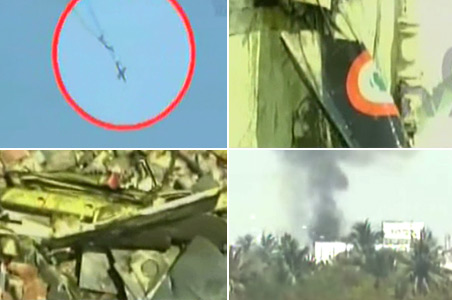
Image Copyright - NDTV
A Navy aircraft crashed into a residential building in a crowded area during an airshow in Hyderabad. At least one person, the pilot, is believed to have been killed. The other casualties are not known yet.
The aircraft that crashed was a Kiran MK-II aircraft belonging to the 'Sagar Pawan' aerobatic team of the Navy. Sources say after doing dive formation that was part of the air show organized for the inaugural event of the India Aviation Summit, the planes were levelling out before flying off in different directions.
Eyewitnesses say the plane nose-dived in a free fall. Rescue team says plane hit cell tower before crashing. Hyderabad police commissioner AK Khan has told NDTV that the pilot is suspected to have died.
Source: http://www.ndtv.com/news/cities/disaster-at-hyderabad-air-show-17130.php
Tuesday, February 23, 2010
NEWS FLASH - Army captain, jawan killed in Kashmir gunbattle
SRINAGAR - Two men of the counter-insurgency force Rashtriya Rifles were killed and four injured in a gunfight with separatist guerrillas in Jammu and Kashmir's Sopore town Tuesday morning, police said.
A captain and a trooper were killed and three troopers and a civilian injured.
A senior police officer told IANS that personnel of Rashtriya Rifles, Central Reserve Police Force (CRPF) and Special Operations Group (SOG) of the local police surrounded two houses in Chinkipora locality of Sopore town, 54 km from here, early morning following information about presence of militants inside.
"The holed-up militants were asked to surrender upon which they resorted to heavy automatic gunfire at the surrounding security men.
"One captain and a jawan were killed in the militant fire and four other persons including three jawans and a civilian were wounded," the police officer said.
The injured troopers have been evacuated to the army's base hospital in this summer capital of Jammu and Kashmir while the injured civilian has been admitted for specialised treatment in the bone and joint hospital here.
"The gunfight is still on and additional reinforcements have been rushed to the spot to ensure that the holed-up guerrillas do not escape," the police officer said.
Source: http://timesofindia.indiatimes.com/india/Army-captain-jawan-killed-in-Kashmir-gunbattle/articleshow/5606864.cms
A captain and a trooper were killed and three troopers and a civilian injured.
A senior police officer told IANS that personnel of Rashtriya Rifles, Central Reserve Police Force (CRPF) and Special Operations Group (SOG) of the local police surrounded two houses in Chinkipora locality of Sopore town, 54 km from here, early morning following information about presence of militants inside.
"The holed-up militants were asked to surrender upon which they resorted to heavy automatic gunfire at the surrounding security men.
"One captain and a jawan were killed in the militant fire and four other persons including three jawans and a civilian were wounded," the police officer said.
The injured troopers have been evacuated to the army's base hospital in this summer capital of Jammu and Kashmir while the injured civilian has been admitted for specialised treatment in the bone and joint hospital here.
"The gunfight is still on and additional reinforcements have been rushed to the spot to ensure that the holed-up guerrillas do not escape," the police officer said.
Source: http://timesofindia.indiatimes.com/india/Army-captain-jawan-killed-in-Kashmir-gunbattle/articleshow/5606864.cms
Monday, February 22, 2010
What has the Army really given you?
I was all of 48 yrs when I was superseded in my present rank. At a social-do, I was asked by this pretty girl, "Just 48, and the end of the road for you! What has Army really given you? You´ve never been paid well in the Army. And see what they have done to you now!"
I appraised her from top to bottom. I must confess she was a pretty sight. What I told her was this.
Army, my dear, is a way of life. It is not about making a living. As far as supercession is concerned, lady, that is way of army life. You can´t complain just because your personal interest, as you perceive it, has not been looked after. Army has wonderful, time-tested evolved systems. You don´t fight personal battles for the heck of it. And it is about selfishness, dear - Service Before Self is our motto.
Remember it is a Service (seva). There are no expectations of rewards in Seva, for Seva is considered its own reward. `What has Army given me?´, you asked. It has given me a glimpse and understanding of dimensions you, in the civil sector, can only wonder and feel over-awed about. Have you any idea of camaraderie?
When you see a soldier brave the shower of artillery shrapnels to rush to rescue his bleeding colleague just wounded in the shelling you KNOW the meaning of the word `camaraderie´ . When you are lying in a hospital on a DI List, and there are 20 blood donors of your blood-group spending the cold night in the verandah of the hospital, just so that any emergency call for blood to save your life may be attended to, that is camaraderie. Camaraderie implies selfless help and support to someone who is not necessarily a friend. You have to cross Banihal, my dear, to understand all this.
Do you know the holy significance of the word `command´? It is a sacred word. And who can know the meaning of it other than a person in uniform? Even the CEO of a Fortune 500 company can´t comprehend the significance of this sacred word. When you are in `command´ you are God. Can you comprehend what being God can be like? It is not about the authority, it is about responsibility. The authority comes into play after you have rendered your part of the deal of unflinching loyalty displayed towards your subordinates. Now when you signal him - not ask him or tell him or order him - to dash-down-crawl- observe- fire, and in the process subject himself to imminent death, he does so without a second thought. This is when you REALIZE what is so sacred about command. Even before you can move your hand to the door of the car/ gypsy, the driver jumps from his seat and beats you to the door, your door, is what command gets you. Such are the rewards of command.
Do you know the meaning of 'being a gentleman'? In the last thirty years in uniform one has witnessed a proliferation of designations in the civil environment. There have been Executive Officers, and there have been Managers - General Mangers, Assistant Managers, and a whole spectrum of them. There are CEOs and Vice Presidents. In the Army we have only 'Officers'. Some are General Officers and some just Company Officers. Even at the induction level we have Young Officers. What it means to be an 'Officer' is something you can´t comprehend. Hollywood tried to bring about a differentiation, calling the phenomenon, 'An Officer and a Gentleman', little knowing that being a gentleman is inherent when you are an OFFICER. Being a gentleman is his primary nature, not second-nature. His behaviour is bhadra - i.e. kalyan-kaarak swabhav, guna, aur karma. Army imbibes this peculiar quality in us when we are as young as 17 to 20 years only. I´ll explain with an example. An officer once held the door open for a particular lady. She, trying to be smartly polite said, "You don't have to hold the door open for me just because I'm a lady." He replied, "Ma'am, I'm not holding it for you because you are a lady, but because I'm a gentleman." We may appear to be ruthless egoists, but we are Enlightened Egoists.
In the corporate world have you ever come across the word 'honour'? In uniform we serve only for honour, not the 'package'. Naam, Namak, Nishan - are alien words in the corporate world. You know what it means to serve for honour? When a subordinate, who already has a bad ankle, is told of a mission which entails 12 hours of walk in the most rugged terrain; and when he expresses reservation on account of his current physical condition, is told that if we can´t do it, it will be a smudge on the regiment; AND THERE IS NO ONE TO REPLACE HIM. He says he'll do his bit. He climbs 10 ropes ahead of everyone else only to find that there is no one behind him and the mission is thus called off. He reports from the top, only 5840m (nearly 20000 ft!), that he with two others of his team are on top and no one is in sight, either behind him or ahead (enemy). He comes back to the base two days later - and what an ankle he has! A swollen ankle with 10-inch girth!!! That is working for the honour.
Army has commanders at every level - langar commander, section commander/ detachment commander, platoon commander/troop commander, and up the chain to Brigade Commanders, and General Officers Commanding in Chief. The General Officers in command of field forces are the best in their league. What is implied by the term 'commander'? Maybe something you in the corporate world will never get to know. To be a commander implies responsibility, complete responsibility. As a commander you are responsible for every dimension of your command - right from his morning cup of tea, his toilet facilities, his professional training, his mental makeup, his family's well being and his spiritual requirements. In the Army we first train young boys, and now even young girls like you, to be an Officer and then to be a Commander, in that order. Can you get an idea, even an iota of it, Lady? Can you get a feel of why we feel distinctly proud, and display it, when we say, 'We in the Army ....'.
Post Script
"I am already 25 year old. I suppose I can´t get enrolled to be an officer. What can I do now?", she asked me at a later get-together. "The best option for you now is to become an Army Wife!", I suggested. Two years later this girl married a young Major. Now I only hope and pray that the Army Officers of the future do not belittle this young Army Wife's perception of our Army as I experienced during 'my times'.
An article by Col (Retd) Abhay Gupta.
I appraised her from top to bottom. I must confess she was a pretty sight. What I told her was this.
Army, my dear, is a way of life. It is not about making a living. As far as supercession is concerned, lady, that is way of army life. You can´t complain just because your personal interest, as you perceive it, has not been looked after. Army has wonderful, time-tested evolved systems. You don´t fight personal battles for the heck of it. And it is about selfishness, dear - Service Before Self is our motto.
Remember it is a Service (seva). There are no expectations of rewards in Seva, for Seva is considered its own reward. `What has Army given me?´, you asked. It has given me a glimpse and understanding of dimensions you, in the civil sector, can only wonder and feel over-awed about. Have you any idea of camaraderie?
When you see a soldier brave the shower of artillery shrapnels to rush to rescue his bleeding colleague just wounded in the shelling you KNOW the meaning of the word `camaraderie´ . When you are lying in a hospital on a DI List, and there are 20 blood donors of your blood-group spending the cold night in the verandah of the hospital, just so that any emergency call for blood to save your life may be attended to, that is camaraderie. Camaraderie implies selfless help and support to someone who is not necessarily a friend. You have to cross Banihal, my dear, to understand all this.
Do you know the holy significance of the word `command´? It is a sacred word. And who can know the meaning of it other than a person in uniform? Even the CEO of a Fortune 500 company can´t comprehend the significance of this sacred word. When you are in `command´ you are God. Can you comprehend what being God can be like? It is not about the authority, it is about responsibility. The authority comes into play after you have rendered your part of the deal of unflinching loyalty displayed towards your subordinates. Now when you signal him - not ask him or tell him or order him - to dash-down-crawl- observe- fire, and in the process subject himself to imminent death, he does so without a second thought. This is when you REALIZE what is so sacred about command. Even before you can move your hand to the door of the car/ gypsy, the driver jumps from his seat and beats you to the door, your door, is what command gets you. Such are the rewards of command.
Do you know the meaning of 'being a gentleman'? In the last thirty years in uniform one has witnessed a proliferation of designations in the civil environment. There have been Executive Officers, and there have been Managers - General Mangers, Assistant Managers, and a whole spectrum of them. There are CEOs and Vice Presidents. In the Army we have only 'Officers'. Some are General Officers and some just Company Officers. Even at the induction level we have Young Officers. What it means to be an 'Officer' is something you can´t comprehend. Hollywood tried to bring about a differentiation, calling the phenomenon, 'An Officer and a Gentleman', little knowing that being a gentleman is inherent when you are an OFFICER. Being a gentleman is his primary nature, not second-nature. His behaviour is bhadra - i.e. kalyan-kaarak swabhav, guna, aur karma. Army imbibes this peculiar quality in us when we are as young as 17 to 20 years only. I´ll explain with an example. An officer once held the door open for a particular lady. She, trying to be smartly polite said, "You don't have to hold the door open for me just because I'm a lady." He replied, "Ma'am, I'm not holding it for you because you are a lady, but because I'm a gentleman." We may appear to be ruthless egoists, but we are Enlightened Egoists.
In the corporate world have you ever come across the word 'honour'? In uniform we serve only for honour, not the 'package'. Naam, Namak, Nishan - are alien words in the corporate world. You know what it means to serve for honour? When a subordinate, who already has a bad ankle, is told of a mission which entails 12 hours of walk in the most rugged terrain; and when he expresses reservation on account of his current physical condition, is told that if we can´t do it, it will be a smudge on the regiment; AND THERE IS NO ONE TO REPLACE HIM. He says he'll do his bit. He climbs 10 ropes ahead of everyone else only to find that there is no one behind him and the mission is thus called off. He reports from the top, only 5840m (nearly 20000 ft!), that he with two others of his team are on top and no one is in sight, either behind him or ahead (enemy). He comes back to the base two days later - and what an ankle he has! A swollen ankle with 10-inch girth!!! That is working for the honour.
Army has commanders at every level - langar commander, section commander/ detachment commander, platoon commander/troop commander, and up the chain to Brigade Commanders, and General Officers Commanding in Chief. The General Officers in command of field forces are the best in their league. What is implied by the term 'commander'? Maybe something you in the corporate world will never get to know. To be a commander implies responsibility, complete responsibility. As a commander you are responsible for every dimension of your command - right from his morning cup of tea, his toilet facilities, his professional training, his mental makeup, his family's well being and his spiritual requirements. In the Army we first train young boys, and now even young girls like you, to be an Officer and then to be a Commander, in that order. Can you get an idea, even an iota of it, Lady? Can you get a feel of why we feel distinctly proud, and display it, when we say, 'We in the Army ....'.
Post Script
"I am already 25 year old. I suppose I can´t get enrolled to be an officer. What can I do now?", she asked me at a later get-together. "The best option for you now is to become an Army Wife!", I suggested. Two years later this girl married a young Major. Now I only hope and pray that the Army Officers of the future do not belittle this young Army Wife's perception of our Army as I experienced during 'my times'.
An article by Col (Retd) Abhay Gupta.
Friday, February 19, 2010
NEWS FLASH - IAF MiG-21 crashes in West Bengal, pilot safe
NEW DELHI: An Indian Air Force MiG-21 combat jet crashed soon after take-off from Bagdora in West Bengal on Friday but the pilot ejected to safety, an IAF spokesman said.
"The aircraft crashed around 3pm soon after take-off and the pilot, squadron leader Rahul Tiwari, ejected safely," the spokesman added.
"The pilot was picked up by an SAR (search and rescue) helicopter and has been taken to hospital," the spoksman said.
This is the second crash of an IAF fighter in three days. A MiG-27 had crashed near the Hashimara air base, also in West Bengal, on Tuesday.
Source: http://timesofindia.indiatimes.com/india/IAF-MiG-21-crashes-in-West-Bengal-pilot-safe-/articleshow/5593107.cms
Video: http://timesofindia.indiatimes.com/videoplay_show
"The aircraft crashed around 3pm soon after take-off and the pilot, squadron leader Rahul Tiwari, ejected safely," the spokesman added.
"The pilot was picked up by an SAR (search and rescue) helicopter and has been taken to hospital," the spoksman said.
This is the second crash of an IAF fighter in three days. A MiG-27 had crashed near the Hashimara air base, also in West Bengal, on Tuesday.
Source: http://timesofindia.indiatimes.com/india/IAF-MiG-21-crashes-in-West-Bengal-pilot-safe-/articleshow/5593107.cms
Video: http://timesofindia.indiatimes.com/videoplay_show
Thursday, February 18, 2010
NEWS FLASH - Decorated Army officer left dead on road for 3 hrs
NEW DELHI: A 44-year-old decorated Army officer was hit by an unidentified vehicle early Wednesday morning and left lying on Africa Avenue in south Delhi for hours. The police noticed him there, but surmised that he was dead. About three hours later, he was taken to AIIMS trauma centre where he was declared "brought dead".
The family of Major Alok Singh, who was director administration at KPMG after taking early retirement from military service, is distraught — it feels Maj Singh might have been alive had not the police been so casual in dealing with the accident. The doctors seem to agree.
"Whether a trauma victim is dead or not, is not for the police to decide, nor are they trained for it," said Dr Amit Gupta, assistant professor of surgery who is attached with the AIIMS trauma centre. There is a "golden hour" within which if a trauma victim gets medical attention he might be revived.
The incident has not just brought back the harsh spotlight on the heartless city which has little time, leave aside a sense of duty, for accident victims, it has also raised questions about the training of police — whether they know the do's and don'ts of dealing with accidents.
Maj Singh left his Safdarjung Enclave home at 6am for his usual morning walk at Deer Park. He normally returned by 8am, but when he didn't until 8.30am, his wife called his cellphone. It was answered by a cop. "The policeman said he had met with an accident and was being taken to hospital," said Rahul Jain, a friend and neighbour.
Source: http://timesofindia.indiatimes.com/city/delhi/Decorated-Army-officer-left-dead-on-road-for-3-hrs/articleshow/5585574.cms
The family of Major Alok Singh, who was director administration at KPMG after taking early retirement from military service, is distraught — it feels Maj Singh might have been alive had not the police been so casual in dealing with the accident. The doctors seem to agree.
"Whether a trauma victim is dead or not, is not for the police to decide, nor are they trained for it," said Dr Amit Gupta, assistant professor of surgery who is attached with the AIIMS trauma centre. There is a "golden hour" within which if a trauma victim gets medical attention he might be revived.
The incident has not just brought back the harsh spotlight on the heartless city which has little time, leave aside a sense of duty, for accident victims, it has also raised questions about the training of police — whether they know the do's and don'ts of dealing with accidents.
Maj Singh left his Safdarjung Enclave home at 6am for his usual morning walk at Deer Park. He normally returned by 8am, but when he didn't until 8.30am, his wife called his cellphone. It was answered by a cop. "The policeman said he had met with an accident and was being taken to hospital," said Rahul Jain, a friend and neighbour.
Source: http://timesofindia.indiatimes.com/city/delhi/Decorated-Army-officer-left-dead-on-road-for-3-hrs/articleshow/5585574.cms
Tuesday, February 16, 2010
NEWS FLASH - MiG-27 crashes in West Bengal, pilot killed

New Delhi: A MiG-27 fighter aircraft of the Indian Air Force (IAF) crashed in West Bengal on Tuesday, Defence Ministry officials said. The pilot was killed in the accident. The fighter plane took off from the Hashimara air force base. The pilot, Wing Commander Aswal, was killed in the crash.
In previous incidents related to this aircraft, the IAF lost two of its Russian-made MiG-27s in crashes last year.
In May 2009, a MiG-27 crashed at Jodhpur, and in October another MiG-27 crashed near New Jalpaiguri in West Bengal. In both cases, the pilots ejected safely.
Image Source: http://nueveg.files.wordpress.com/2009/06/9_mig27-01.jpg
Monday, February 15, 2010
Brave Major dies fighting chain-snatcher
Tiruchy, Feb. 5: An army major was murdered by an unidentified miscreant on Thursday evening when he prevented the culprit from snatching the jewels of his wife at knife-point at Mukkombu, near here.
Ramesh (33), son of Rangasamy, a resident of Tumkur, in Karnataka, and serving as army doctor in Visakhapatnam, was in Tiruchy the past few days to screen aspirants who attended the army recruitment rally at Tirunelveli recently.
Accompanied by his wife Anuradha (27), two-year-old daughter Mridhula and in-laws, he went to Mukkombu on Thursday. When they were about to leave the place around 6.45 pm an unidentified man approached Anuradha and threatened her at knife-point to part with her jewels.
When Anuradha cried for help, Ramesh, standing a few metres away, came rushing to her rescue. Sensing that he might get caught, the culprit started to run. However, Ramesh gave chase and caught hold of his shirt. Unable to escape his clutches, the culprit stabbed him in the throat. Since Ramesh did not loosen his hold even then, the culprit wriggled out leaving his shirt behind.
Ramesh was rushed by his relatives to a private hospital at Pettavaithalai where he was declared as brought dead. The body was then brought to the government hospital. Central zone IG Karan Singha visited the spot and conducted enquiries. Tiruchy rural district SP A. Kaliyamurthy said the duo ran till the main road and boarded a bus. Col Sanjeev Kumar, director (recruiting), Army recruitment office, Tiruchy, said the body of the ‘brave officer’ was given full army honours.
Subscribe to:
Posts (Atom)

